


Dua e Istikhara is the prayer Muslims recite when they feel unsure about a big decision.
It is taught in Sahih al-Bukhari and takes only two rak’ahs and a short dua.
Here you will find the Arabic text, English translation, and transliteration in one place.
You will also learn how to pray Istikhara step by step.
We explain when to perform it and how many times you can repeat it.
Most importantly, you will see the real signs of Istikhara and clear up the dream and color myths.
The Deep Meaning and Importance of Istikhara in Islam

Istikhara is a way of handing a hard choice to Allah after you have done your own thinking.
This section explains what it is, where the word comes from, and why it matters.
What Is Dua e Istikhara?
Dua e Istikhara is a supplication taught by the Prophet Muhammad ﷺ to seek Allah’s guidance before making a permissible decision.
A Muslim prays two voluntary rak’ahs and then recites the dua, keeping the matter in mind.
Any Muslim who can pray two rak’ahs can perform it, and no scholar or imam is needed.
It can be used for marriage, work, travel, study, and other lawful choices.
It is a request for what is truly best for you.
It is not a way to predict the future.
Linguistic Meaning: Seeking Goodness
The word Istikhara comes from the Arabic root khayr, which means goodness or what is best.
It literally means asking Allah to choose what is best for you.
In simple terms, you ask Allah to choose, because His choice is always better than your guess.
Theological Significance: An Act of Ultimate Trust
Istikhara is an act of tawakkul, which means relying on Allah after you have taken your own steps.
It admits that humans cannot see the future, while Allah knows what is hidden.
The Quran reminds believers that you may dislike something that is good for you (Surah Al-Baqarah 2:216).
Istikhara puts that lesson into practice.
The Importance of Dua e Istikhara in a Believer’s Life
- It replaces anxiety with calm, because the choice is placed in Allah’s hands.
- It helps reduce regret, since the decision is made with guidance and not only emotion.
- It builds the habit of turning to Allah before every important step.
- It helps you accept the outcome, because the dua ends by asking for contentment.
For these reasons, Dua e Istikhara is one of the most practical gifts of the Sunnah.
It supports a believer in every stage of life, from small choices to life changing ones.
The Prophetic Origin: Dua e Istikhara in Hadith
Jabir ibn Abdullah (may Allah be pleased with him) reported that the Prophet ﷺ taught the companions Istikhara in all matters, just as he taught them a surah of the Quran (Sahih al-Bukhari 1166).
The same hadith is also recorded in Sahih al-Bukhari 6382 and 7390.
This comparison shows how important and how practical the dua is.
The hadith tells believers to pray two voluntary rak’ahs, then recite the dua and name the matter.
Because it comes from authentic hadith and not from the Quran, it is a Sunnah practice.
The wording of the dua is therefore fixed and should be recited as the Prophet ﷺ taught it.
Only the matter you name in your heart changes from one decision to another.
The Complete Dua e Istikhara: Arabic, Transliteration, and Translation
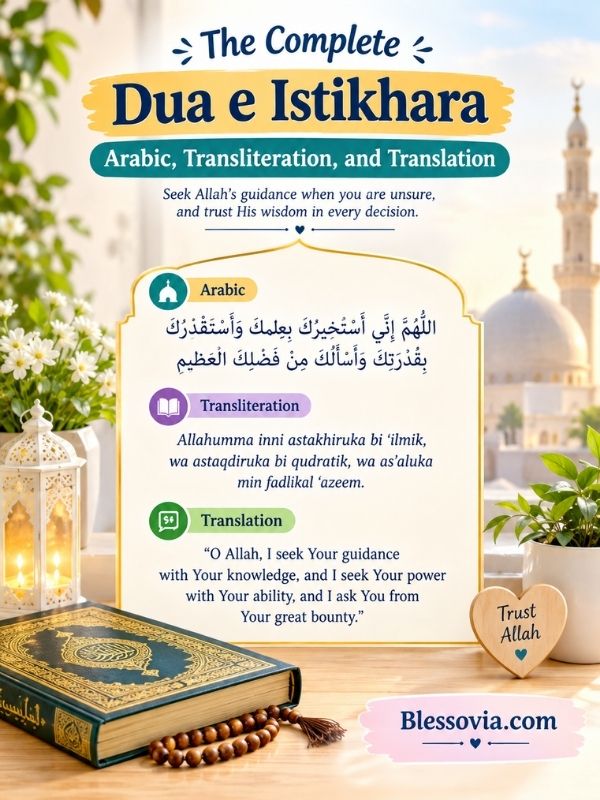
Recite this Dua e Istikhara after the two rak’ahs.
When you reach the words “hadha al amr” (this matter), name your decision in your heart.
Learning the dua by heart is rewarding, but you may also read it from paper or a phone after the salam.
Read it slowly and try to understand each line.
Dua e Istikhara in Arabic
اللَّهُمَّ إِنِّي أَسْتَخِيرُكَ بِعِلْمِكَ، وَأَسْتَقْدِرُكَ بِقُدْرَتِكَ، وَأَسْأَلُكَ مِنْ فَضْلِكَ الْعَظِيمِ، فَإِنَّكَ تَقْدِرُ وَلَا أَقْدِرُ، وَتَعْلَمُ وَلَا أَعْلَمُ، وَأَنْتَ عَلَّامُ الْغُيُوبِ. اللَّهُمَّ إِنْ كُنْتَ تَعْلَمُ أَنَّ هَذَا الْأَمْرَ خَيْرٌ لِي فِي دِينِي وَمَعَاشِي وَعَاقِبَةِ أَمْرِي، فَاقْدُرْهُ لِي وَيَسِّرْهُ لِي ثُمَّ بَارِكْ لِي فِيهِ. وَإِنْ كُنْتَ تَعْلَمُ أَنَّ هَذَا الْأَمْرَ شَرٌّ لِي فِي دِينِي وَمَعَاشِي وَعَاقِبَةِ أَمْرِي، فَاصْرِفْهُ عَنِّي وَاصْرِفْنِي عَنْهُ، وَاقْدُرْ لِيَ الْخَيْرَ حَيْثُ كَانَ ثُمَّ أَرْضِنِي بِهِ.
Transliteration
Allahumma inni astakhiruka bi ‘ilmika, wa astaqdiruka bi qudratika, wa as’aluka min fadlikal ‘azeem. Fa innaka taqdiru wa la aqdiru, wa ta’lamu wa la a’lamu, wa anta ‘allamul ghuyub. Allahumma in kunta ta’lamu anna hadhal amra khayrun li fi deeni wa ma’ashi wa ‘aqibati amri, faqdurhu li wa yassirhu li, thumma barik li fih. Wa in kunta ta’lamu anna hadhal amra sharrun li fi deeni wa ma’ashi wa ‘aqibati amri, fasrifhu ‘anni wasrifni ‘anhu, waqdur liyal khayra haythu kana, thumma ardini bih.
Dua of Istikhara with English Translation
“O Allah, I ask You to guide me to the best choice through Your knowledge, and I ask for ability through Your power. I ask You from Your great bounty. You are able and I am not. You know and I do not. You are the Knower of the unseen.”
“O Allah, if You know that this matter is good for my religion, my livelihood, and the outcome of my affairs, then decree it for me, make it easy for me, and bless me in it.”
“And if You know that this matter is bad for my religion, my livelihood, and the outcome of my affairs, then turn it away from me and turn me away from it. Decree for me what is good wherever it is, and make me content with it.”
Dua e Istikhara in Urdu and Roman Urdu
Here is the Urdu meaning of the dua, written in Roman Urdu for easy reading.
Ae Allah, main tere ilm ke zariye tujh se khair mangta hoon, aur teri qudrat ke zariye tujh se taqat mangta hoon, aur tujh se tere azeem fazl ka sawal karta hoon. Beshak tu qudrat rakhta hai aur main nahi rakhta, tu jaanta hai aur main nahi jaanta, aur tu ghaib ki baaton ko khoob jaanne wala hai. Ae Allah, agar tu jaanta hai ke ye kaam mere liye mere deen, meri maeeshat aur mere anjaam ke liye behtar hai, to use mere liye muqaddar kar de, aasaan kar de, phir mere liye us mein barkat de. Aur agar tu jaanta hai ke ye kaam mere liye mere deen, meri maeeshat aur mere anjaam ke liye bura hai, to use mujh se door kar de aur mujhe us se door kar de, aur jahan bhi khair ho wo mere liye muqaddar kar de, phir mujhe us par raazi kar de.
Dua e Istikhara Meaning Explained Line by Line
- “I seek the best choice through Your knowledge”: Allah knows every result, and you do not.
- “I seek ability through Your power”: Only Allah can make a good path possible.
- “I ask from Your great bounty”: You ask for a gift, not a right.
- “If this matter is good for me”: You ask Allah to decree it, ease it, and bless it. The dua names three areas: religion, livelihood, and the final outcome.
- “If it is bad for me”: You ask Allah to turn it away from you and turn you away from it.
- “Make me content with it”: This is the heart of the dua, because it asks for peace with whatever Allah decrees.
Some narrations use the words “in my present and future affairs” in place of “the outcome of my affairs”.
Dua e Istikhara Short
Some people use a short supplication when they need a quick dua: “Allahumma khir li wakhtar li” (O Allah, choose what is best for me and select for me).
Some scholars consider its chain weak.
It can be said as a general dua.
It does not replace the full dua taught in Sahih al-Bukhari.
How to Perform Salat al-Istikhara: A Step-by-Step Guide
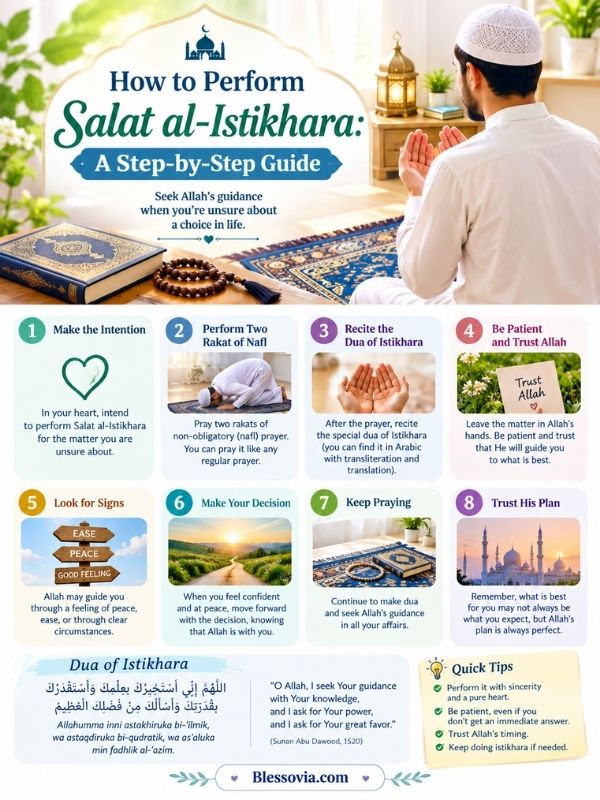
The method is simple and takes only a few minutes.
Dua e Istikhara is prayed like any other voluntary prayer, so no special posture is needed.
Follow the steps below in order.
Purification and Intention (Niyyah)
Make fresh wudu and face the qibla.
Form the intention in your heart to pray two rak’ahs of Istikhara for your specific matter.
You do not need to say the niyyah aloud.
Perform Two Rak’ahs of Prayer
Pray two voluntary (nafl) rak’ahs like any other prayer.
After Al-Fatihah, you may recite any surah.
Some scholars suggest Surah Al-Kafirun in the first rak’ah and Surah Al-Ikhlas in the second.
This is a recommendation, not a requirement.
Recite the Dua e Istikhara
Recite the dua after the salam, with your hands raised.
Some scholars also allow reciting it before the salam.
At the words “hadha al amr”, pause and think about your exact decision.
Arabic is preferred, but if you cannot recite it yet, ask in your own language while you learn the Arabic.
What to Do If You Cannot Pray Two Rak’ahs
If you cannot pray, for example during menstruation or illness, scholars say you may still recite the dua alone.
Do not delay an urgent decision only because the prayer is not possible.
When you are able to pray, you may also offer the two rak’ahs.
When Should One Perform Dua e Istikhara?

Perform it when you face a permissible decision and cannot decide.
The best approach is to gather information and ask for advice first.
Dua e Istikhara works best when your heart is open to either result.
Is Istikhara Only for Big Decisions?
No. The hadith says the Prophet ﷺ taught it for all matters.
It is most useful when you are unsure, but it can also be used for smaller choices.
It is not for obligatory or forbidden acts, because their ruling is already clear.
Best Time and Prohibited Times for Istikhara
You can pray Istikhara at any time when a voluntary prayer is allowed.
The last third of the night is a special time for dua.
| Time | Ruling |
| Last third of the night | Best time for dua |
| After Isha or before sleep | Allowed |
| Sunrise | Avoid |
| Midday, when the sun is at its highest | Avoid |
| Sunset | Avoid |
Some schools of thought also avoid voluntary prayer after Fajr and Asr, so follow your own school.
Istikhara for Marriage
Istikhara is commonly prayed when considering a marriage proposal.
Before praying, make sure you have done the following:
- Met and spoken with the person in a proper setting.
- Asked about their character, faith, and family background.
- Consulted parents or trusted elders.
- Listed your real concerns and priorities.
Then pray Istikhara and move forward with the choice that becomes easier.
The person who will marry should pray it, while parents can make general dua for guidance.
Istikhara for Job, Business, and Travel
It suits choices like accepting a job offer, starting a business, signing a deal, or moving to a new city.
Research the options, compare the risks, and ask people with experience.
Then pray Istikhara and take the best practical step.
Understanding the Signs and Results of Istikhara

Istikhara does not promise a dream or a voice.
Guidance usually comes through ease, obstacles, and a settled heart.
A Feeling of Inclination
After Istikhara, your heart may lean gently toward one option.
This often happens gradually, over a few days.
A calm feeling about one choice and unease about the other can be a sign.
Do not confuse a strong personal desire with guidance.
Facilitation or Obstruction
When one path opens easily, it may be a sign of good.
When doors keep closing despite sincere effort, Allah may be turning the matter away from you, as the dua asks.
Look at real circumstances, not coincidences.
Information and Counsel
New facts or advice from a trustworthy person can clarify your decision.
Allah often guides through people and knowledge.
Consultation (shura) is praised in the Quran (42:38).
What If No Clear Sign Comes?
That is normal.
Choose the most reasonable option based on your research and advice, then trust Allah.
If the choice is not good for you, He can turn it away.
Waiting for a perfect sign can delay the decision and increase worry.
Istikhara is meant to reduce confusion, not create more.
What to Do After Istikhara: Consult, Decide, and Trust Allah
- Consult: Talk to trusted and knowledgeable people.
- Decide: Choose the most reasonable option.
- Act: Do not wait for a dream before moving forward.
- Trust: Accept the outcome with patience.
Common Questions and Misconceptions about Dua for Istikhara
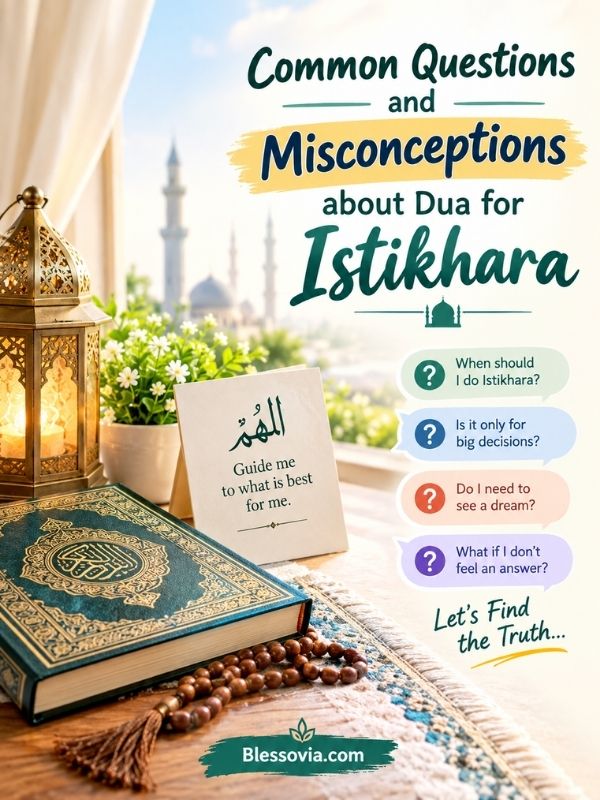
These are quick answers to the most common doubts.
Can someone else perform Istikhara for me?
It is best to pray it yourself, because the decision is yours.
Some scholars allow asking a pious person to make dua for you, but that does not replace your own Istikhara.
How many times can I perform it for the same matter?
There is no fixed limit.
Some scholars mention up to seven times, but this number comes from a narration they consider weak.
Repeat it if the situation changes or you still feel unsure.
Do not repeat it only out of anxiety.
Is Dua e Istikhara in Quran?
No. The dua comes from authentic hadith in Sahih al-Bukhari.
The Quran supports its ideas of relying on Allah and consulting others (2:216 and 42:38).
Do I need to see a dream or a color after Istikhara?
No. No authentic hadith requires a dream.
The belief that white means yes and black means no is a cultural habit, not Islamic teaching.
If a dream comes, treat it only as possible reassurance.
Can I recite Dua e Istikhara in English or Urdu?
Arabic is preferred because the Prophet ﷺ taught the dua in Arabic.
If you do not know it yet, you may say its meaning in your own language while you learn it.
The Relationship Between Istikhara (Guidance) and Istighfar (Forgiveness)

Istikhara asks Allah for the best choice ahead.
Istighfar asks Allah to forgive past mistakes.
Many scholars encourage repentance before any dua, because a clean heart is more present.
The Prophet ﷺ himself sought forgiveness more than seventy times a day (Sahih al-Bukhari).
A simple habit is to seek forgiveness, pray the two rak’ahs, and then make Dua e Istikhara with a calm heart.
Frequently Asked Questions
Is Istikhara fard or Sunnah?
It is a Sunnah, not a compulsory act.The Prophet ﷺ taught it, and Muslims are encouraged to pray it whenever they need guidance.
Which surahs should I recite in the Istikhara prayer?
No surah is required.
Recite Al-Fatihah and any surah you know, though some scholars suggest Al-Kafirun and Al-Ikhlas.
Do I have to sleep after Istikhara?
No. Nothing in the hadith requires sleep.
You can continue your day as normal.
What if I forget to mention my matter during the dua?
Repeat the dua and name the matter.
Allah knows your sincere intention.
How long does it take to get an answer after Istikhara?
There is no fixed time.
Guidance may become clear in a few days or take longer.
Act on your best choice and watch how things unfold.
Can I read the dua from my phone or paper?
Yes. You can read it from paper or a phone after the salam.
Reading with understanding is better than rushing through it from memory.
What is the difference between Istikhara and Istishara?
Istikhara is asking Allah for guidance through prayer.Istishara is consulting people.
Islam encourages both: consult first, then pray Istikhara.
Final Thoughts
Dua e Istikhara is a simple Sunnah that turns confusion into calm.
It needs only two rak’ahs, a short dua, and a sincere heart.
Remember that the signs usually come as ease, obstacles, and a settled heart, not as dreams or colors.
Research and consult first, then act with trust.
Keep the dua close and use it whenever a choice feels heavy.
Allah’s choice is always better than our own, so move forward with confidence and peace.